
    Bournemouth University

    Centre for Fusion Learning Innovation and Excellence

    Embedding excellence through fusion of education, research and professional practice

    • Brightspace Staff Resources
    • Learning Design Hub
    • Engaging Assessment Practices
    • GenAI Resource Hub

    Can sustainability be taught?

    Posted June 11, 2019. Filed under AdvanceHE, Co-creation, Communities of Practice, Curriculum design, Education, employability, Events and workshops, HE Students, Public Engagement, Sustainability, Teaching and Learning.

    Education for sustainable development (ESD) is a major development area at Bournemouth University. Here is a blog post from Dr Karen Thompson:


    At the FoM ‘Sustainability Symposium’ yesterday, we explored what sustainability means for teaching and learning.
    Sustainability is high on the list of priorities for BU, with KPIs for aligning all courses and research with one or more of the UN’s 17 Sustainable Development Goals and the launch of a Strategic Investent Area for ‘Sustainability, Low-Carbon Technology and Material Science’ last week.  Yesterday an audience of academics, students, professional services colleagues and external practitioners came together to better understand the crises facing humanity today.

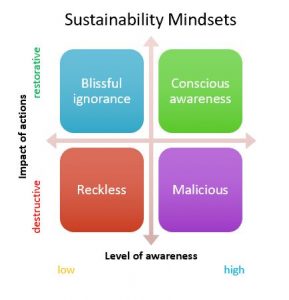
    Gwyn Jones, Director of Association of Sustainability Practitioners, argued for sustainability to be viewed as the outcome of conscious thinking.    Accordingly, sustainability is experienced and practised rather than learnt in a classroom and is enacted as a mindset.

    Four mindsets have been identified and our challenge is to move society and our learners towards the top right quadrant of conscious awareness.


    The question we asked was ‘What does extinction mean for business?’   It became clear that the question is relevant not only to the Business School, but for all disciplines at BU as indicated by a comment from one participant “I found it really interesting and frankly rather scary (and I’m informed) … I’m keen to try to do something similar [in my Faculty] and be active in this agenda more broadly” (FC).

    Most models of business are based on assumptions that value profit and growth above all else.  Many of these models were developed during the industrial revolution and are now contributing to the destruction of our environment and society.  According to Gwyn, those who claim to have answers to sustainability, don’t understand the problem.

    We discussed new business models and case studies that are based on understandings of purpose and decision-making that balances competing priorities.  One student who was with us for the day commented “I am very excited to interact with all the bright minds in the room discussing sustainability … it was a great day for me” (Sacha, MBA student).

    So, what does this mean for programmes and pedagogy?  We can no longer rely solely on text books because we are only just starting to uncover the questions we need to ask.  Understanding how we can live sustainably with ‘enough for everyone, forever’ has not been addressed before and we do not have answers yet.  We need to be comfortable asking difficult questions and seeking answers in novel ways.  Social learning is one approach being used to develop new concepts.  Dr Karen Thompson and Dr Nigel Williams have been collaborating with practitioners to ask novel questions and develop new resources for education, research and practice of Responsible Project Management.
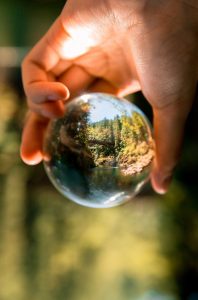
    An argument made by Karen is that sustainability should not be seen as an ‘add on’ to the curriculum, rather it should be used as a lens through which we view all aspects of our discipline.

    Experiential learning will be important for developing a sustainability mindset among learners.  ‘Living Labs’ are recognised in BU2025 and can be expected to play a useful role for both education and research in the future.  We need to develop learners’ sense of agency and confidence that they can make a difference in the world.  Virtual reality may have a role to play in developing the capabilities for managing more responsibly.  Lastly, we need to encourage our graduates to become advocates for better decision-making in the organisations they will work in.

    There are two related blogs from the ‘Sustainability Symposium’, please click here and here to access

    For further information, or for advice about running your own sustainability event, please contact Dr Karen Thompson or Professor Janet Dickinson, both from Faculty of Management


    Leave a Reply

    Click here to cancel reply.

    Your details
    • (Your email address will not be published in your comment)

    XHTML: You can use these tags: <a href="" title=""> <abbr title=""> <acronym title=""> <b> <blockquote cite=""> <cite> <code> <del datetime=""> <em> <i> <q cite=""> <s> <strike> <strong>

    Subscribe for FLIE Blog updates

    We offer FLIE Blog updates to offer subscribers a weekly digest of posts made on the FLIE site. To subscribe to these email updates, simply subscribe below.

    Click here for more information.

    Archives

    • August 2025
    • July 2025
    • June 2025
    • May 2025
    • April 2025
    • March 2025
    • February 2025
    • January 2025
    • December 2024
    • November 2024
    • October 2024
    • September 2024
    • August 2024
    • July 2024
    • June 2024
    • May 2024
    • April 2024
    • March 2024
    • February 2024
    • January 2024
    • December 2023
    • November 2023
    • October 2023
    • September 2023
    • August 2023
    • July 2023
    • June 2023
    • May 2023
    • April 2023
    • March 2023
    • February 2023
    • January 2023
    • December 2022
    • November 2022
    • October 2022
    • September 2022
    • August 2022
    • July 2022
    • June 2022
    • May 2022
    • April 2022
    • March 2022
    • February 2022
    • January 2022
    • December 2021
    • November 2021
    • October 2021
    • September 2021
    • August 2021
    • July 2021
    • June 2021
    • May 2021
    • April 2021
    • March 2021
    • February 2021
    • January 2021
    • December 2020
    • November 2020
    • October 2020
    • September 2020
    • August 2020
    • July 2020
    • June 2020
    • May 2020
    • April 2020
    • March 2020
    • February 2020
    • January 2020
    • December 2019
    • November 2019
    • October 2019
    • September 2019
    • August 2019
    • July 2019
    • June 2019
    • May 2019
    • April 2019
    • March 2019
    • February 2019
    • January 2019
    • December 2018
    • November 2018
    • October 2018
    • September 2018
    • August 2018
    • July 2018
    • June 2018
    • May 2018
    • April 2018
    • March 2018
    • February 2018
    • January 2018
    • December 2017
    • November 2017
    • October 2017
    • September 2017
    • August 2017
    • July 2017
    • June 2017
    • May 2017
    • April 2017
    • March 2017
    • February 2017
    • January 2017
    • December 2016
    • November 2016
    • October 2016
    • September 2016
    • August 2016
    • July 2016
    • June 2016
    • May 2016
    • April 2016
    • March 2016
    • February 2016
    • January 2016
    • December 2015
    • November 2015
    • October 2015
    • September 2015
    • August 2015
    • July 2015
    • June 2015
    • May 2015
    • April 2015
    • February 2015
    • January 2015
    • December 2014
    • October 2014
    • September 2014
    • August 2014
    • June 2014
    • April 2014
    • January 2014

    Other services

    © Bournemouth University 2025. All rights reserved.

    • Charitable status
    • Website privacy & cookies
    • Copyright and terms of use