The Leverhulme Visiting Professorship awarded to Dr Suelen Carls was conceived not simply as a visiting appointment, but as a curated programme of intellectual exchange, designed to deepen interdisciplinary research, strengthen internationalisation, and embed global perspectives within CIPPM’s teaching and research culture.
Over six months, the Professorship hosted Professor Mohamed Amal, an internationally recognised scholar in International Business and International Economics. The programme was deliberately structured around a methodological progression — combining lectures, seminars, and interactive workshops — to ensure that research conversations translated into pedagogical innovation, student engagement, and longer-term research collaboration.
Programme Design and Methodology
Rather than treating the Visiting Professorship as a series of standalone events, the programme was developed as a coherent research and teaching pathway. Core lectures introduced students and staff to the economic foundations of intellectual property, innovation, and international business. Seminars then created space for comparative and critical dialogue across law, economics, and development studies. Workshops focused on applied research methods, case-study analysis, and interdisciplinary framing.
This structure of the Leverhulme Lecture Series enabled sustained engagement across different audiences — postgraduate students, early-career researchers, and established academics — and reinforced CIPPM’s commitment to research-led education and impact-oriented scholarship.
Student Research and Knowledge Co-Creation
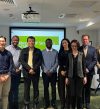
A central objective of the Visiting Professorship was to place students at the heart of the research environment. This culminated in a student-focused session where LLM students Dominic Ou, Zechariah Annan, Kennedy Kimiri, Mario Garcia, and Salwa Mouhajer presented their on-site research and final findings developed during the programme.
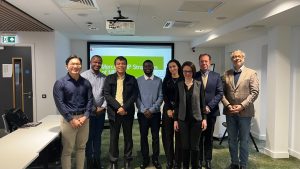
Their work addressed complex questions at the intersection of intellectual property, innovation, international business, and economic development, reflecting both doctrinal and empirical approaches. The session was enriched by the participation of Professor Alberto Ribeiro de Almeida and Professor Davide Parrilli, whose engagement added comparative insight, methodological critique, and mentoring value.
This format exemplified the programme’s emphasis on knowledge co-creation, exposing students to international scholarly traditions while strengthening their confidence as emerging researchers.
CIPPM Seminar: EU–Mercosur at a Crossroads
The Visiting Professorship concluded with a CIPPM seminar entitled “The EU–Mercosur Agreement at a Crossroads: Intellectual Property, Law, and Geopolitical Implications.” Moderated by Dr Suelen Carls, the seminar brought together three complementary perspectives:
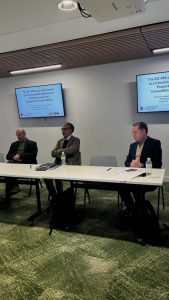
- Professor Alberto Ribeiro de Almeida examined the intellectual property chapter of the EU–Mercosur Agreement, focusing on geographical indications, trademarks, and regulatory harmonisation.
- Professor Davide Parrilli explored the role of SMEs in national and regional economies, addressing competitiveness, innovation, and SME–MNE relations through a Latin American cluster case study.
- Professor Mohamed Amal reflected on the economic foundations of the agreement, with particular attention to innovation, foreign direct investment, and development trajectories in emerging economies.
Together, the discussion situated intellectual property within broader debates on trade governance, regional integration, and geopolitical uncertainty.
Strategic Value and Looking Forward
Awarded to Dr Suelen Carls to host Professor Amal, the Leverhulme Visiting Professorship has contributed directly to CIPPM’s research environment, supporting internationalisation, interdisciplinarity, and impact-oriented engagement. The programme has strengthened academic networks across Europe and Latin America, informed ongoing research on IP and global governance, and created foundations for future collaborative outputs.
Importantly, the Professorship demonstrates how visiting schemes can be used strategically, not only to enhance individual projects, but to shape institutional research culture, student experience, and longer-term international partnerships.