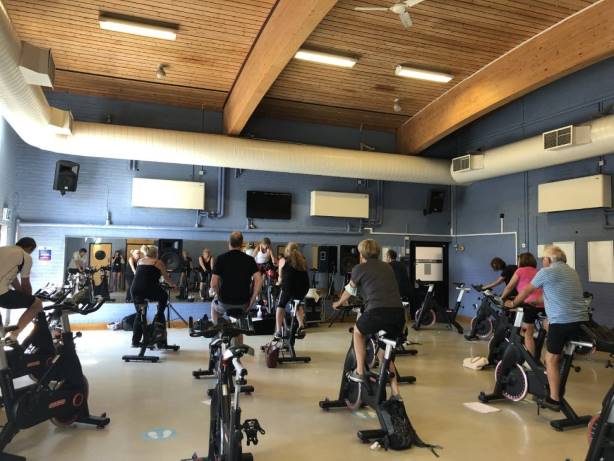
CHAIN spin class
CLEAT: A Study to Compare Physiotherapy Treatment with a Static Cycling and Education Programme to Help Improve Hip Pain
There is no known cure for osteoarthritis, and the latest National Institute for Health and Care Excellence (NICE) guidelines for people with symptoms not yet severe enough for surgery recommend education and advice, exercise (including local muscle strengthening and aerobic exercise) and weight loss, if needed, and so it is important to develop these strategies further to support patients.
The purpose of the CLEAT study is to investigate whether people who receive an 8 week education and static cycling treatment (The CHAIN programme) have an improvement in their hip function and less pain than those patients who receive physiotherapy treatment as per standard care and practice within the NHS.

Cycling may be of benefit in comparison to other forms of exercise because it is a healthy form of physical activity, is a non-weight bearing activity that is considered less stressful on the body than impact or other running sports, and has been shown to improve muscle weakness.
In this study, half of the 221 recruited participants were randomised to receive standard physiotherapy treatment that was available through the NHS. The other half of the patients received weekly group education and static cycling sessions designed to increase strength and function through physical activity.
The study showed improvements in performing daily activities, pain levels, and quality of life for both groups after treatment. However, people on CHAIN reported greater improvements in performing daily activities and quality of life. CHAIN was also found to be more cost-effective for the NHS compared to usual physiotherapy care. The research has recently been published in The Lancet Rheumatology, which can be viewed here.
More information can be found on the CLEAT website.
This project is funded by the National Institute for Health and Care Research (NIHR) under its Research for Patient Benefit (RfPB) Programme (Grant Reference Number PB-PG-0816-20033). The views expressed are those of the authors and not necessarily those of the NIHR or the Department of Health and Social Care.